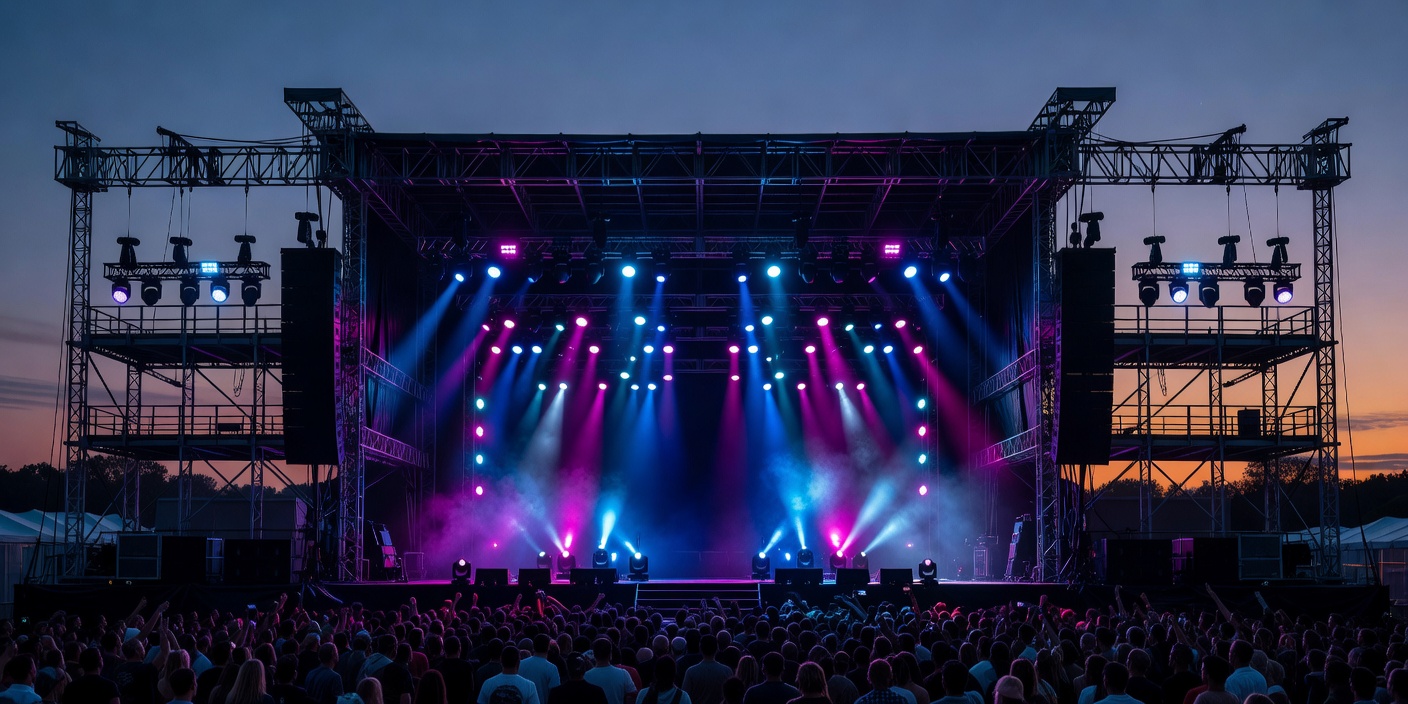
Modern outdoor music festivals demand extraordinary visual impact while staying within tight power distribution budgets and strict truss weight tolerances. The key to achieving this balance lies in hybrid lighting fixture architecture—combining high-output LED wash/spot profiles with traditional discharge strobes and IP65-rated beam units.
1. Ethernet Data Topology: Art-Net & sACN Distribution
Relying solely on 5-pin XLR DMX runs across a 100-meter main stage is a recipe for signal degradation and ground loop hum. Modern hybrid rigs utilize redundant gigabit Ethernet trunks running sACN (Streaming ACN) or Art-Net 4 protocols.
- Opto-Splitter Isolation: Place managed gigabit switches on upstage left and right trusses with opto-isolated DMX nodes at every truss junction.
- Universe Segmentation: Assign primary moving lights to Universes 1–16, key lights to Universes 17–20, and atmospheric pixels/strobes to Universes 21–40.
2. Managing Power Draw and Phase Balance
Three-phase power distribution units (distros) require careful phase loading. Unbalanced neutrals in 3-phase systems can generate harmonic distortion, causing sensitive digital LED driver electronics to reboot mid-show.
When patching fixtures across L1, L2, and L3, calculate the peak draw of high-discharge fixtures alongside the inrush current of cold-striking LED arrays to ensure even distribution across all three legs.
3. Truss Load Margins & Environmental Sealing
Outdoor summer festivals frequently face sudden wind gusts and heavy downpours. Utilizing IP65-rated hybrid fixtures eliminates the need for bulky rain covers, reducing wind sail area and structural strain on mid-stage trusses.
→ Calculate your next festival patch using our DMX Address Engine